For business
At first glance, we look like a photo booth business. And that’s intentional.
Your logo on the overlay. A QR code that leads to your site. A survey question asked while your guest is still smiling. None of it feels like marketing to the person standing in front of the mirror — that’s the strategic business development practice running underneath the booth.


We already know you have a great product, service, offer or opportunity for people. That part is yours — I am not here to tell you your own business.
But are you delivering it in a way that differentiates you from your competition? That increases conversion? That increases engagement? That sets you apart from everyone else in the room?
That is where I come in, as the amplifier. I take what you already have and clarify it and amplify it, so more of the right people actually hear it, engage with it, and act on it. The booth is the vehicle. What is actually running underneath it is a strategic marketing and business development practice, built around your goal.
Anyone can rent a booth space, buy a tablecloth and attend an event — but do you have actual target outcomes strategized? What’s the plan? What actually gets your message further than that is someone applying a plan and reading the room live, on your behalf, while it is happening — connecting your business to the right people in that room, which is what increases your engagement and your conversion, not just having equipment present.
I have built that reputation in Prince George’s business and networking circles over years of doing exactly this — ask around, and people will point you to events I have worked and what it did for the business that hired me.
Concretely, that means the booth’s own tools — a QR code guests scan, survey questions asked while they’re still standing there, your branded overlay, a prompt to share the photo to social — are effective on their own. Their effectiveness increases when they are planned out strategically with clear deliverables in mind, and delivered by someone with decades of sales and marketing experience. That is why I call it intentional.
Here is what that looks like in practice: a printed sign asking guests to share something about your event gets largely ignored, the way most signs at an event do. The same message, delivered by someone with the experience to read the moment and a plan for when to raise it, gets a real response. Same technology, planned and delivered with experience instead of left to run itself — that is the difference in reach for your message.
Raven’s Occasions provides business development, market development, process improvement, technology implementation, and workforce development support to Prince George area businesses — delivered alongside experiential marketing services, including an interactive mirror photo booth.
In other words: I make your job easier. Better conversations with your customers. The word getting out without you having to think about it. The right people showing up when you need to hire. I find whatever’s causing the delay, build a system for it, and hand it back to you — so you’re not spending all day on the tools and all night on a computer trying to catch up on the business side.
I’ve worked blue collar and I’ve worked white collar, so I can meet your organization where it’s at. Call it “process optimization,” or just call it this: your staff scans a QR code in the field, fills out a form on their phone, and it lands in a spreadsheet that pings you and whoever else needs to know. Jargon or not, it’s the same thing — I can talk either way.
Here’s why the jargon matters. I can help you assess your business for where we can create strategic solutions — whether that’s selling your product, getting higher engagement, or applying for funding that’s available to you. I can help connect the dots on how your business might be eligible for different kinds of funding: to bring on more people, to increase training for new or current staff, or to bring on a consultant like myself.
For example: I can come in with strategic business solutions — process optimization, scheduled deliverables, increased stakeholder engagement, increased ROI on event attendance.
Or, in plain terms: I meet with you, build a strategy for the event you’re attending, and you walk away with clear deliverables — contact information, content for your social media, and real feedback from your customers about your products or services.
Both of those are describing the same thing. I know the linguistics — I know how to speak both. Because it’s the same thing. Funding often gets overlooked simply because of corporate jargon.
Ever done a home show and driven home with nothing to show for it but a stack of business cards someone scribbled a name on? That’s event remorse. Book me instead and you go home with photos and video for your social media, an actual email list, and a survey built into the experience that tells you what your customers actually want — not just names on a draw slip.
Examples, not a package
A few tools in the toolbox
Think of it like having a personal chef rather than ordering off a set menu. Corporate clients do not pick from a fixed combo — the plan gets curated specifically to what your business needs, pulled from a toolbox of options. A few examples below, not an exhaustive list — each one works on its own, and works even better as part of a planned strategy.
- Lead and contact capture, with consent — when that is the goal, asked plainly and recorded clearly, while I am the one asking.
- A branded print that outlasts a business card — kept on a fridge or a desk long after the cards from the same event hit the recycling bin. That is the return on your event, still working for you weeks later.
- Survey data from your own guests — asked live, in the moment, by a person reading the room. Guests skip the same question on a touchscreen far more often than they answer it when I ask it out loud.
- The photo shared straight to the guest’s inbox — your branding travels home with them the moment they walk away from the booth.
- A social-share prompt while the room is still full — delivered by me, in person, timed to the moment. A printed sign asking the same thing gets ignored the way most signs do.
- A live sharing gallery that becomes your content library — every photo from the night, ready for your own social media and advertising afterward.
- An audio guest book, pointed at your business — reviews, testimonials and answers to the question you actually want asked, in your customers’ own voices, reusable in your marketing with their consent.
- A trained team, not just a rented booth — I work the floor beside your staff, sharing the marketing, sales and engagement moves in real time: how to open a conversation, keep someone talking, and handle an objection with a real customer standing there.
- Tangible data for your own stakeholders — the post-event debrief hands you what happened, not just how it felt.
- A reason to stop at your booth, not just walk past it — on a trade show floor where a row of engineering firms all look interchangeable, booth to booth, the mirror photo booth is the reason someone walks over to yours first.
None of this is a fixed package. It is a toolbox, and knowing which pieces to reach for is most of the job — and none of it does much on its own without someone there running it live.
The cost of showing up empty-handed
Attending or hosting an event is a real expense. Even a basic backdrop and tablecloths cost money.
Spend that money, show up, and have no strategic plan or tools in place to capture value from it — and that expense produces nothing lasting.
That holds even at a goodwill event. Wanting to reach people who are already interested in hearing from you is not a conflict with supporting a good cause — the debrief afterward is what you bring back to your own stakeholders to show for it.
What’s actually running the experience
What this produces for you
The booth itself is a DSLR camera on a Windows system, not a tablet propped behind glass — that matters because it means real integration options, and a photo that holds up. Guests see themselves in the mirror, follow the on-screen prompts, and their photo lands in a live online gallery within seconds. Every branded overlay carries your logo and, where it fits your goal, a QR code straight to your site.
Survey questions and screening questions live in that same flow, asked while the guest is still standing there and still feeling good about the experience — not on a form they take home and never fill out.
Where the print package is booked, guests leave with a physical 4×6 in a gold-embossed paper frame and envelope — the piece people actually keep, long after the cards from the same event are gone.
The live gallery keeps building for 30 days after the event, and you get full download access afterward — a reusable photo library for your own channels, not a folder you never open. The audio guest book runs the same idea through a different sense: reviews, testimonials and answers to the question you want asked, in a customer’s own voice.
Anything not listed here has not been confirmed for your event — ask, and I will tell you plainly what is and is not included.
In practice
Three ways this actually shows up
The plumbing company at a trade show
A plumbing and heating company wants to know who in the crowd is likely eligible for a toilet-replacement rebate program. The screening questions go straight into the booth’s survey flow — guests answer them for their photo, and the company walks away with a shortlist of likely-eligible leads, not a stack of business cards to sort through later.
A row of interchangeable engineering firms
At most industry trade shows, every booth looks the same — banner, logo, a table, a couple of people hoping somebody stops. The mirror photo booth is the reason people walk over to yours first, and the conversation your team has once they are there is the actual point.
And the one most businesses already recognize: a home show, a stack of business cards someone scribbled a name on, and nothing else to show stakeholders afterward. That is event remorse, and it is exactly what the booth, the survey and the debrief are built to prevent.
How data actually gets collected
Consent is real, not a checkbox for show
- A guest can decline consent, full stop — if that happens, the session is cancelled. There is no “we’ll still do the photo anyway.”
- Every survey question is optional. Decline any of them and the guest still gets their photo — no pressure, ever.
- Nothing is gathered quietly. The booth’s elements — the QR code, the email opt-in, the survey questions — get pointed out naturally, in the moment, as part of getting the photo, never as a separate pitch.
- The follow-up email and any list opt-in depend on your goal for that event, and we agree on that before the day. A goodwill or fundraiser event usually gets a soft opt-in checkbox, no pressure. A lead-generation event can tie the digital copy to joining your list — as long as a no-strings print option stays available, so nobody is forced into it.
The data and conversion a client wants comes from guests genuinely enjoying themselves, not from anyone feeling tricked, slighted or pressured. That is not a compromise on the results — it is why the results hold up.
The short version
Just need a photo booth?
Then you are two clicks from done. Four packages, fixed prices, attended throughout, and no consultation required.
Weddings & private events
Planning something personal instead?
It is intentional here too — just a different kind of intentional. A plain, joyful photo booth experience is complete and valuable entirely on its own. No strategy attached, no deliverables required.
I bring a mother’s warmth to a wedding or milestone photo booth, and real finesse navigating whatever family dynamics show up in the room — getting the photo with the divorced parents without anyone blowing up, for instance. I work quietly in the background rather than drawing attention to myself, so the moment stays about the people celebrating it, not about me.
The same strategic problem-solving that runs through the business side crosses over here too. Need something sourced, a vendor issue sorted out, or a specific problem worked through for your day? Ask — if I cannot solve it myself, I likely know who can.
Or start here
What brought you to this page?
Hiring & wage subsidy
Could part of your next hire’s wages be covered?
For a lot of Prince George businesses, the answer is yes — and they never find out, because the paperwork looks like more trouble than it is worth.
Government funding and grant writing, hiring, recruitment, and everything else on the workforce side of this business lives on its own page now, with the full range up front — not just the wage subsidy. See the consulting page for how it works, what WorkBC actually covers, and what working together looks like.
Systems, sales & operations
The unglamorous parts that decide whether the rest works
Most of what I do comes down to two things: helping people make money, and helping them stop losing it. That is usually where I start looking.
What follows is not a service menu. These are the things I actually get asked about, and what working backwards from them tends to look like.
Your staff have completely different comfort levels with technology
Some of your people want pen and paper. Some want everything on a phone. Both are right, and a system that only serves one of them gets quietly abandoned by the other.
That usually means a hybrid: forms that can be filled out in the field on paper or on a screen, documentation people will actually open, and automation for the parts nobody should be retyping.
There is too much paperwork and some of it could probably be automated
Often true. Not always worth it. The useful version of that conversation is which parts are worth automating, which parts just need a better form, and which parts should stop being done at all.
Practical pieces I can help with: documentation and SOPs, office systems, field forms, a simple CRM that does not cost you a subscription forever, Google Business Profile and Meta Business Suite setup, and the Canva materials you keep meaning to make.
You have a great product and no real sales process
It does not matter how good the product is if nobody knows how to sell it. That is a process problem and a training problem, not a personality problem, and both can be built.
You keep hiring people and the results are not what you need
They leave. They were not trained. They did not have the experience. Or the labour pool simply does not contain the finished person you are picturing, and the real answer is hiring for potential and building the rest.
Where it fits, the WorkBC Wage Subsidy and the Employer Training Grant can carry part of that cost. Eligibility gets assessed, never assumed — that is the hiring and wage subsidy side of this.
Consulting is quoted on what you actually need — the problem, the objective, the scope, and whether anyone else has to be brought in. There is no rate card, because there is no standard job.
Where I stop
I do not pretend to know how to do everything
What I do know how to do is work out what needs to happen, find the bottleneck, and figure out who can solve it.
Sometimes that is me. Sometimes it is someone else, and I would rather send you to the right person than sell you the thing I happen to own. Businesses in this town do better when they refer each other properly, and I take that seriously.
Either way you get a practical answer instead of a sales pitch for something you do not need.
Conferences & trade shows
You are one booth on a floor of hundreds
Two questions worth answering before you ship a banner across the province: what makes somebody stop, and what happens once they do?
Most exhibitors solve the first one with a bowl of pens and hope for the second. A mirror photo booth solves it differently — people come over because they want to, and they stay long enough for your team to have an actual conversation.
What are you spending to be there?
Booth fee. Travel. Hotel. Staff time, which is the expensive one nobody puts on an invoice. Signage, banners, printed material, promotional items. Days out of the shop.
If you are investing that much to be in the room, the question worth asking is not whether you showed up. It is what you want to come home with.
An example: the energy expo
A company is going to an energy expo. Same floor as everyone else, and most of the booths look much the same. The question I usually get is “how do we get people to stop?”
The answer is not automatically a bigger booth. It starts with a different question: what do you want people to actually do?
- Leave you their contact information
- Answer a few survey questions
- Give you a testimonial in their own words
- Remember your company next week
- Understand what you actually sell
- Have a real conversation with your staff
Once we know the answer to that, the booth becomes a tool rather than the plan. It gives people a reason to stop, a reason to stay, and something to talk about while they are standing there. Questions get asked at the moment people are happiest to answer them. The photo goes home with your name on it.
The goal is not “everybody loved the photo booth.” The goal is what your company brought home from the event.
How I run a corporate event
Before
We talk first, and the question is not “what package.” It is what you are actually trying to get out of the room — leads, brand awareness, a product launch, honest feedback from your industry. The setup follows from the answer.
On site
Your branding on the experience and on everything guests take away. Attended the whole time, so your team can talk to people instead of running the equipment.
Capture
Where it fits your goal, the booth can collect contact details and feedback — consent first, every time, clearly asked and clearly recorded. Nothing is gathered quietly.
After
A debrief. What drew people, what they said, what to do differently at the next show. The part almost nobody does, and the reason the next one goes better.
Somebody has to start the conversation
Not everyone likes walking up to strangers. I do.
I will work the room. I will draw people over, get them curious, explain what you do, introduce you, and hand the conversation to your team once it is warm. If your people would rather spend their time talking to the ones who are genuinely interested, this is what frees them up to do that.
I can also train your own staff to do it, which is worth more to you in the long run than hiring me every time.
How I represent you. I will happily get people interested in what you do. I will not make things up to do it. I work with people and businesses I can genuinely stand behind, and a referral only means something if people know I am going to be straight with them.
Insurance. I carry $5 million commercial general liability insurance, and can provide a certificate of insurance on request — if your venue or procurement team needs one on file, just ask.
“Who is going to want a photo at a forestry conference?”
Everybody, as it turns out.
Not because they came for a party. Because people want proof they were there — that their company showed up, that their crew was in the room, that they represented their organization. A good photo of coworkers with your branding on it is a post, a keepsake and a record of attendance all at once.
The point is not that engineers secretly love photo booths. The point is that the photo is useful.
And at most industry events every table looks the same: banner, logo, a couple of people standing behind it hoping somebody stops. The part I add is the reason to walk over in the first place.
A dead phone is an opportunity
I have been the person at an event whose phone is at four percent. You are not networking at that point. You are looking for an outlet.
A charging station gives people a reason to stand still near you for fifteen minutes, and fifteen minutes is a conversation. That is the whole thinking behind it — start with what people actually do, then work backwards to the equipment.
You do not need a marketing department
Plenty of businesses want to be at an event and are missing the pieces. No signage. No swag. Nothing printed. Not enough people to work the room. And no clear idea of what they are supposed to accomplish once they get there.
That is a solvable problem. I can help work out what is actually needed, provide some of it, and source the rest — I have access to custom printed materials, and where something falls outside what I do, I will find you someone who does it well.
The Voice Experience
The same technology behind our audio guest book, pointed at a business purpose. Attendees pick up a handset and record a message — a reaction to a product, a piece of feedback, a testimonial in their own voice rather than a survey checkbox. It is branded to you, and what comes back is usable content instead of a spreadsheet, feeding straight into the reusable photo and content library above.
Want it working for you after everyone goes home? I can curate a social media package from the event — photos, clips and voice content selected and prepared for your channels, not handed over as a folder you never open.
Recruiting & career fairs
Candidates meet a dozen employers in an afternoon and remember two. An approachable, interactive booth signals a workplace with personality, and gives a prospective hire a relaxed way to start talking to your team. Long after the fair, the photos on their phone still carry your name.
Hiring off the back of it? That is the other half of what I do — see hiring and wage subsidy on the consulting page.

I work most often with organisations in forestry, energy, mining, industrial and construction, engineering, and the resource sector generally — the companies sending teams to conferences and trade shows where the competition for attention is genuine. Smaller organisations are just as welcome; this is simply where I spend most of my time.
Staff parties & company events
The easy one
Holiday parties, team nights, open houses, product launches, service awards, the summer barbecue. No strategy session required — pick a package and I will be there.
Every package includes the mirror photo booth attended throughout, a professional backdrop, professional softbox lighting, unlimited digital photos, a custom overlay branded to your company, and a live online gallery your team can watch fill up during the event. Setup and teardown never count against your booked hours.
A company or staff event books exactly the way a private one does — see packages and check your date on the pricing page.
Want more out of the night than photos? A custom quote pairs the booth with a business strategy built around what you’re actually trying to get out of it — content you can use on your social media, survey questions and answers from your own guests, increased engagement online, your brand message carried through the whole event, and a targeted offer for your product, service or fundraiser. Tell me what you’re planning and I’ll build a quote around it.
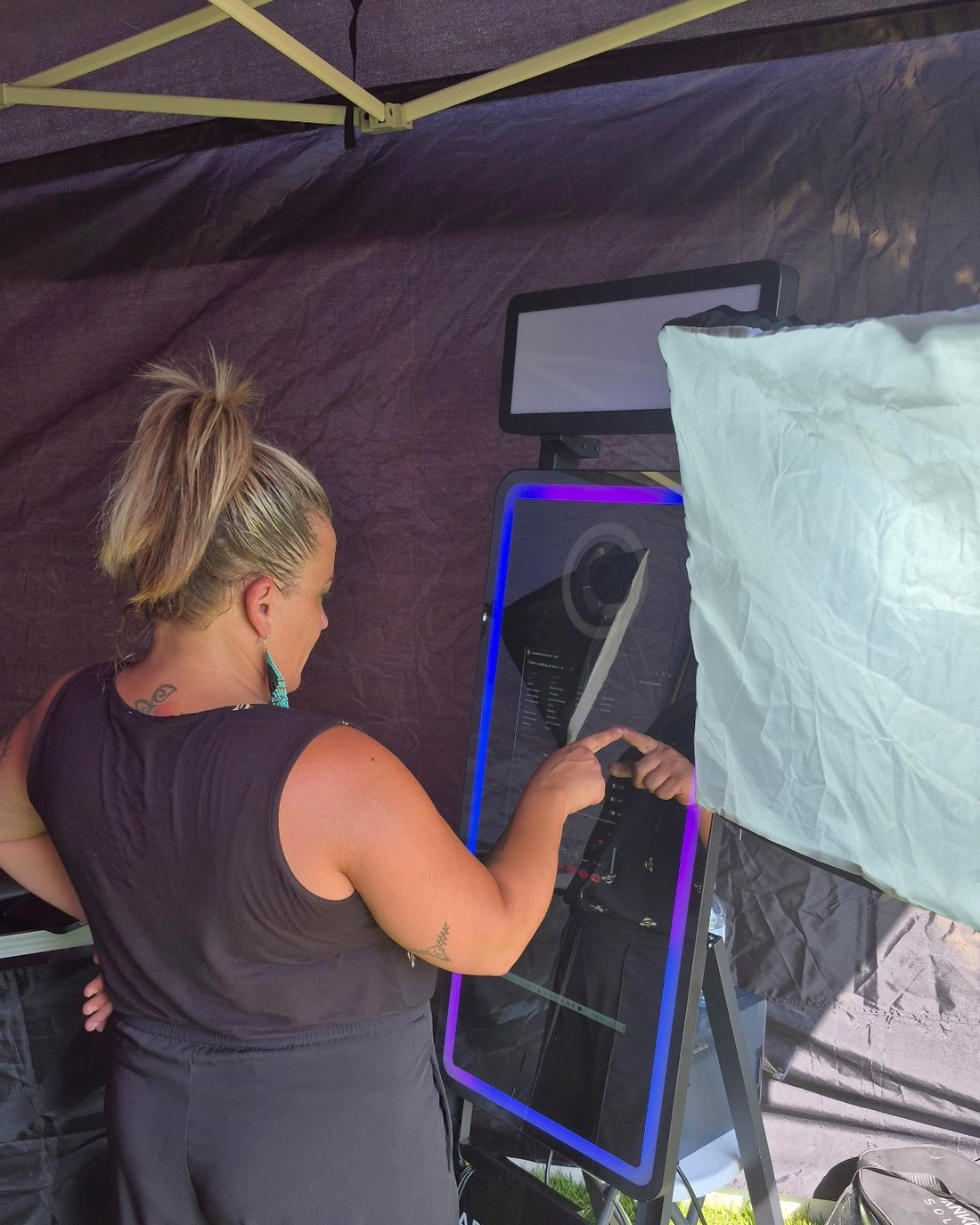
On the floor
This is what your customers actually do at the booth
Business openings, a community day, a centennial. The branded overlay carries the client’s name on every one of these, and the guest still just sees a great photo.


Corporate dates book early — November and December especially. If you have a date in mind, get it held.
Still not sure
Not sure what you need?
That is the most common answer there is, and a perfectly good place to start. Answer a few plain questions, or just tell me what is going on.
Or reach me however is easiest — (778) 983-4669 to call or text, or hello@ravensoccasions.com.
Recent work
See it at a real event
Browse the online galleries from recent bookings — the same galleries guests get on the night.
Not sure which one you need?
Tell me what you are trying to solve and I will tell you straight whether I am the right call.